Local Automotive SEO: Service Costs, DSG Questions and Commercial Intent
Local Automotive SEO: how addressing service costs, DSG transmission questions, and commercial intent helps capture high-value local searches and qualified leads.
ARTIFICIAL INTELLIGENCE
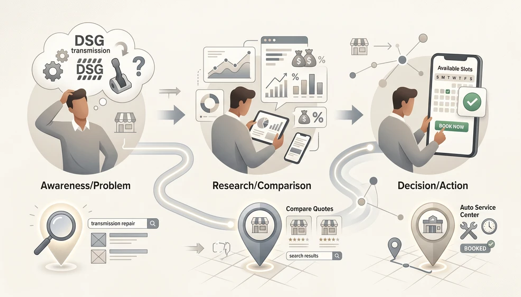
Local automotive SEO succeeds when businesses publish transparent service pricing and technical educational content that matches how car owners actually search. A Budapest auto service ranks positions 3 to 8 for high-value pricing queries and captures featured snippets for DSG transmission problem queries by combining these two content types. This dual strategy intercepts customers at multiple stages of the search journey, from initial research to booking intent.
How Car Owners Search for Services
Automotive service searches follow predictable emotional patterns. A driver notices an unusual noise or warning light. The first reaction is information gathering: researching symptoms, understanding potential causes, and assessing urgency. This phase generates queries like "DSG transmission problems," "turbocharger failure symptoms," or "why is my check engine light flashing."
The second phase shifts toward cost awareness. Once the driver identifies a probable issue, they need to understand the financial implications before committing to a garage visit. Queries evolve into "DSG gearbox repair cost," "turbo replacement price," or specific labor rate searches such as "autószerelés óradíj" (car repair hourly rate in Hungarian).
The third and final phase is selection. The searcher now knows what they need and wants to choose a provider. Queries become location-specific: "auto repair near me," "car service Budapest District 14," or brand-specific searches including the garage name.
Most automotive service websites capture only the final phase. They list services, display contact information, and hope searchers find them by name. The businesses that win organic visibility understand that phases one and two represent the majority of search volume, and they create content that serves those earlier informational needs.
The Service Cost Content Strategy
Why Pricing Pages Work in Automotive SEO
Pricing transparency remains surprisingly rare among auto repair businesses. Many garages resist publishing rates, fearing competitors will undercut them or customers will shop solely on price. This reluctance creates a structural gap in search results that strategic businesses can fill.
Searchers looking for pricing information represent high commercial intent. Someone searching "autószerviz óradíj" (car service hourly rate) has already acknowledged they need professional service. They are not researching DIY solutions. They want to compare providers and budget appropriately.
Published pricing also builds trust signals. A garage willing to display its labor rates upfront communicates confidence in its value proposition. This transparency reduces friction for price-conscious customers who might otherwise delay booking due to cost uncertainty.
Structuring Automotive Pricing Content
Effective pricing pages balance specificity with flexibility. A flat hourly rate provides a baseline for comparison, while clear explanations of variable factors (vehicle type, part quality, job complexity) prevent sticker shock.
The most successful automotive pricing structures include three elements: a clear labor rate, estimated ranges for common services (oil change, brake replacement, diagnostic work), and explanatory notes about what influences final cost. This approach satisfies the searcher's immediate need while setting appropriate expectations.
For multi-location or multi-service operations, individual service pages targeting specific pricing queries outperform general pricing pages. A dedicated "olajcsere ára" (oil change price) page optimized for that exact query will typically outrank a general pricing page that merely lists oil changes among other services.
Use this framework to build pricing pages that match how customers search.
· Lead with the specific service name + pricing language: "General Car Repair Hourly Rate" or "DSG Gearbox Repair Cost"
· Include location when relevant: "Car Service Prices in Budapest"
· Match the exact phrasing customers search for
· State the hourly labor rate clearly and prominently
· Display a table of common services with price ranges (minimum to maximum)
· Separate parts cost from labor cost so customers understand the breakdown
· Specify which vehicle categories the rates apply to (passenger car, SUV, premium brands)
· Brief bullet list explaining why prices vary: vehicle age, OEM vs. aftermarket parts, job complexity
· A note about inspection before final quote for complex repairs
· Link to related service pages for detailed breakdowns
· State the warranty period on labor and parts
· Explain the diagnostic process (free vs. paid)
· Include customer review count or average rating
· Direct booking option: phone number, online form, or scheduling link
· Secondary CTA: "Request a Quote" for uncertain customers
· Operating hours and availability information
· Link to related technical content (e.g., from pricing page to "DSG transmission problems" article)
· Link to general service overview page
· Link to customer reviews or testimonials page
Technical Content That Drives Commercial Intent
The DSG Transmission Content Model
The DSG (Direct-Shift Gearbox) represents a category of automotive content that bridges informational and commercial intent exceptionally well. DSG transmissions are complex, expensive to repair, and widely discussed in owner forums. This combination generates substantial search volume across multiple query types.
Searchers investigating DSG issues typically follow a progression. They begin with problem identification: "dsg váltó hiba jelei" (DSG transmission fault signs), "dsg váltó hibák" (DSG transmission faults), or "dsg váltó" (DSG transmission). These are informational queries driven by genuine concern about vehicle performance.
The same searcher, having confirmed their symptoms match known DSG failures, then transitions to cost-related queries. This is the critical handoff point where a well-structured content strategy captures the commercial intent that informational content generates.
The DSG content model applies to any complex automotive system that creates uncertainty for owners: turbochargers, dual-mass flywheels, common-rail injection systems, and timing chain mechanisms. Each represents an opportunity to own the informational query while building the trust that converts to commercial action.
SERP Feature Opportunities
Technical automotive queries frequently trigger rich results including featured snippets, "People also ask" boxes, and video carousels. Content that directly answers common questions in clear, structured formats has strong potential to capture these positions.
"People also ask" entries for DSG-related queries include questions about symptoms, repair costs, whether problems affect specific vehicle models, and the advisability of purchasing used cars with DSG transmissions. Each question represents a sub-topic that warrants dedicated content.
Capturing Intent Across the Search Journey
The automotive service search journey moves through distinct stages, each with different content requirements. Understanding this progression allows businesses to intercept searchers at multiple points rather than competing solely for high-intent bottom-funnel queries.
Stage One: Informational Content
At the symptom research stage, the searcher wants education, not sales messages. Content should explain how systems work, what symptoms indicate problems, and when urgency matters. The goal is usefulness and authority, not conversion. Include diagnostic checklists, symptom explanations, and guidance on safe operation until repair.
Stage Two: Commercial Research Content
The pricing research stage represents hybrid intent. The searcher still needs information, but the commercial frame is now active. Content should provide transparent cost ranges, explain what factors influence price, and differentiate the service provider on expertise rather than price alone. Testimonials and trust signals become relevant.
Stage Three: Transactional Content
At the selection stage, friction reduction is paramount. Clear booking mechanisms, prominent contact information, service area definitions, and operating hours matter most. The searcher has already decided to book a service; the content's job is to make that action effortless.
The businesses that capture the most organic automotive traffic serve all three stages within a connected content architecture. Pricing pages link to technical content. Technical content links to booking mechanisms. Each page satisfies its specific intent while guiding the searcher naturally toward the next stage.
Local SEO Fundamentals for Auto Services
Content strategy operates within a broader local SEO framework. For automotive service businesses, several foundational elements determine whether content investments translate into visible results.
Google Business Profile Optimization
The Google Business Profile functions as the primary local search touchpoint. Complete profiles with accurate categories ("Auto Repair Shop," "Car Service Center"), detailed service descriptions, regular photo updates, and active review responses consistently outperform sparse profiles regardless of website quality.
Automotive businesses should list specific services within their profile (oil change, brake service, diagnostics, transmission repair) rather than relying solely on the general category. These service listings create additional matching opportunities for service-specific local queries.
Local Schema Markup
LocalBusiness schema with AutoRepair markup helps search engines understand service area, operating hours, accepted payment methods, and specific automotive services offered. Review schema, when legitimately earned and properly implemented, enhances search result presentation with rating stars.
Review Strategy
Automotive service reviews carry significant weight because repairs represent high-cost, high-trust transactions. A systematic review collection process, ideally triggered after service completion, builds the review volume and freshness signals that influence local ranking.
Review responses should demonstrate expertise and professionalism. Responses that address specific service details signal to prospective customers (and to search algorithms) that the business is engaged and knowledgeable.
Location Page Architecture
For single-location businesses, the homepage and service pages carry the full local SEO burden. For multi-location operations, individual location pages with unique, non-duplicate content for each address are essential. Each location page should embed maps, list specific service offerings, and include locally relevant content.
Auto-Szerviz 14: Position Data and Analysis
Auto-Szerviz 14 is a Budapest-based automotive repair service that implemented a combined pricing and technical content strategy. The data below reflects third-party position tracking for targeted queries across the Hungarian search market.
▶ Evidence
Methodology note: Position data sourced from SEMrush third-party estimates. Actual Google rankings may vary by searcher location, device, and search history. SERP feature data reflects observed visibility in rich results, not traditional organic position ranking.
What the Data Demonstrates
The pricing query rankings (positions 3 to 8) illustrate that dedicated pricing pages can compete effectively in a local market against established competitors. Positions 3 for "autószerelés óradíj" and "autószerelő óradíj" place the site above local directories and below only the most dominant local competitors.
The DGS transmission-related SERP features confirm that informational technical content captures visibility in rich results. This informational visibility feeds the commercial funnel: searchers who learn about DSG problems from the content are more likely to return to the same domain when researching repair costs or seeking a service provider.
The combination of both visibility types, commercial pricing positions and informational rich results, creates a full-funnel presence that single-strategy competitors cannot match. Businesses focused only on service pages miss the informational searcher. Businesses focused only on blog content miss the pricing researcher.
▶ Key Insight
Automotive service businesses that publish transparent pricing alongside technical educational content capture both informational and commercial search intent. The informational content builds trust by answering symptom-related questions; the pricing content converts that trust into commercial action. This dual-content approach mirrors how actual car owners search, progressing from problem research to cost comparison to service booking.
Frequently Asked Questions
Sources
1. Auto-Szerviz 14. Official website. auto-szerviz14.hu
2. SEMrush. Keyword position tracking data for auto-szerviz14.hu. Accessed 2025.
3. Google. Local Business structured data documentation.
4. Google Business Profile Help. support.google.com/business
5. Rothaan Consulting. Case studies portfolio.
Plan Your Local Automotive SEO Strategy
Discover how transparent pricing content and technical articles can capture full-funnel automotive search intent in your local market.